· 5 min read · Chetan Chavadi
India at the Crossroads: Youth, Responsibility, and the Road to Progress
“No offense, but a nation can’t sprint if its youth are stuck jogging in circles."
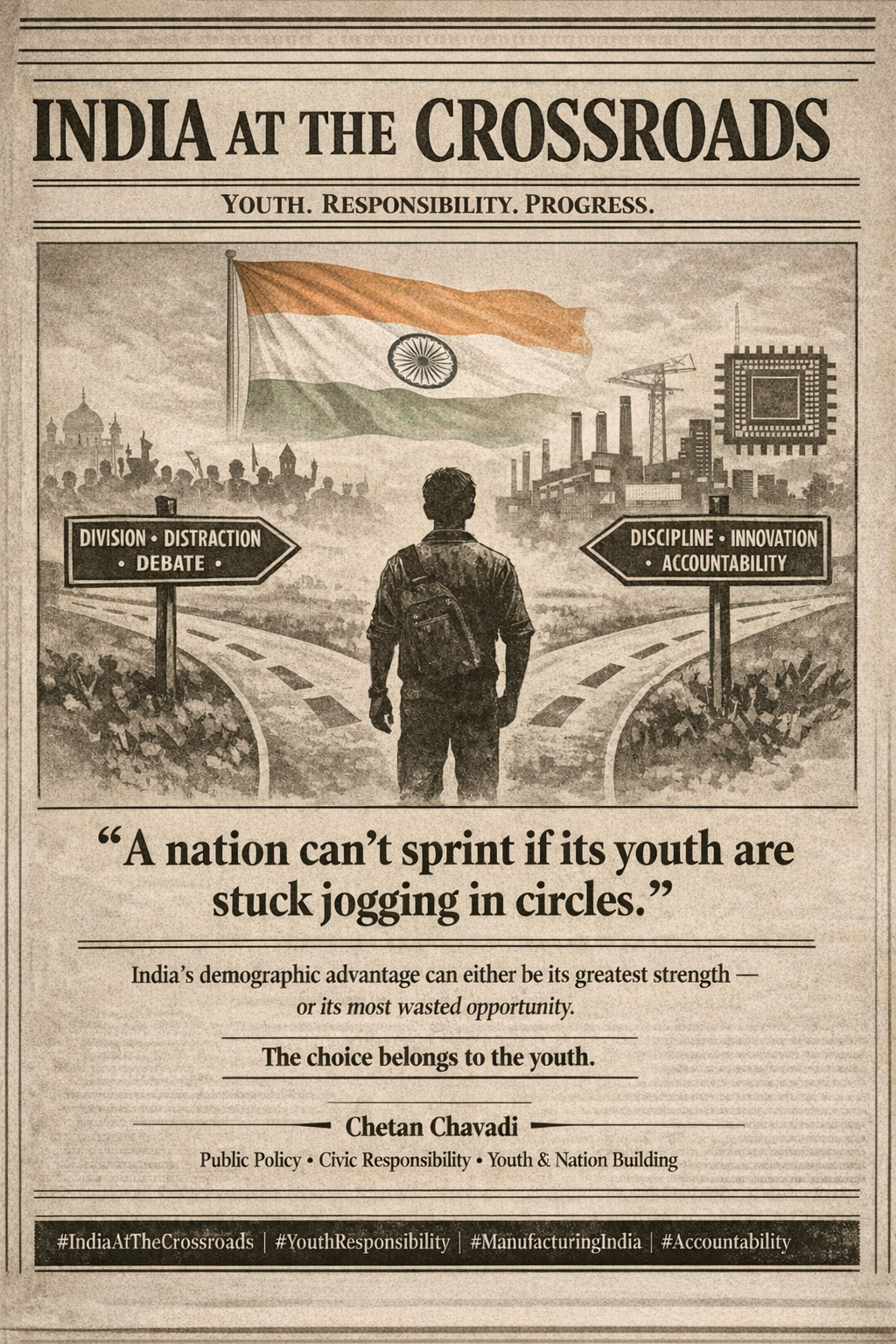
To bring to your notice, the following piece has been crafted by a fellow writer, Chethan Chavadi.
India today stands at a crucial crossroads in its journey as a nation. With one of the youngest populations in the world, the country should be racing ahead in innovation, governance, manufacturing, and global competitiveness.
Instead, much of its energy is consumed by internal divisions, emotional debates, and systemic inefficiencies. This is not a crisis of talent or resources, but a crisis of direction.
The Indian youth, despite its immense potential, is often misaligned from the larger national purpose, and this misalignment is quietly shaping the country’s future.
The youth of India has historically been a force of transformation, from the freedom movement to social reform. Yet in recent times, youth energy is increasingly redirected toward identity-based conflicts and emotional nationalism rather than structural reform. Religion, language, and regional identity once sources of cultural richness are now frequently used as tools for political mobilization.
When young citizens are encouraged to fight among themselves over identity, they stop asking harder questions about education quality, job creation, policy execution, and institutional accountability. A divided youth is easier to manage than a questioning one.
India’s diversity was never meant to weaken it. The coexistence of multiple religions, languages, and traditions is one of the country’s greatest civilizational strengths. However, when identity becomes the primary lens through which governance is viewed, development takes a back seat.
Internal conflicts distract the nation from its real competition, which is not within its borders but beyond them. While India debate’s identity, the world debates innovation, productivity, and scale.
In a healthy democracy, questioning those in power is not an act of disloyalty but a civic responsibility.
Yet questioning the government today is increasingly portrayed as anti-national. This mindset weakens democratic institutions. No political party whether Congress, BJP, or any other should be exempt from scrutiny.
Governments are elected to deliver results, not to command unquestioned loyalty. The youth must ask what was promised, what was delivered, what failed, and who is accountable. Democracy survives not on emotional allegiance, but on informed skepticism.
Modern political systems rarely fail loudly; they fail silently.
By keeping citizens emotionally charged and constantly distracted, systemic inefficiencies remain unchallenged. Social media amplifies outrage but suppresses nuance, reducing complex policy issues into slogans and binaries. As long as the youth remains reactive rather than reflective, pressure for meaningful reform remains weak. Silence, in such a system, becomes a form of consent.
India’s civic deficit is not a policy failure but a youth failure. Youth carry greater responsibility because they know better, can act better, and shape social behavior.
Older generations may be bound by habit children lack agency. Youth have neither excuse. When young people violate civic discipline, it is not ignorance but choice and repeated choice hardens into culture.
Environmental harm justified as tradition, violations turned into entertainment, and public spaces treated as disposable expose selective morality. Posting about sustainability while damaging shared resources is not awareness it is hypocrisy. When youth normalize indiscipline, the state is forced to spend more on enforcement than development.
Youth do not miserly inherit the nation they set its standards. What they excuse today becomes normal tomorrow. India’s demographic advantage will remain a liability unless its youth accept one basic truth: nation-building begins with citizen discipline.
No nation in history has achieved sustained growth or mass employment without a strong industrial base. Manufacturing is not just another sector it is the spine of jobs, exports, and national resilience.
Yet India contributes less than 3% of global manufacturing output, with manufacturing stuck at 16–17% of GDP. For a country absorbing millions of young people into the workforce each year, this is not a passing delay. It is a structural weakness.
The failure is not one of vision, but of follow-through. India spends only 0.6–0.7% of GDP on research and development, leaving innovation thin and dependent. Education rewards degrees, not deployment. We produce graduates fluent in theory but detached from production. The result is familiar: a country rich in ideas, poor in conversion strong at discussion, weak at delivery.
The India Semiconductor Mission (ISM) exposes this gap with uncomfortable clarity. Announced as a strategic push into advanced manufacturing, it offers incentives covering up to 50% of project costs under a ₹76,000 crore package.
Semiconductors are not optional infrastructure; they are the foundation of electronics, defense, automobiles, AI, and industrial power. Nations that possess this capability guard it fiercely.
Yet despite approvals for nearly 10 projects with announced investments of around ₹1.6 lakh crore India still does not have a single operational advanced semiconductor fabrication facility. Projects like the HCL Foxconn unit, projected to produce 20,000 wafers per month and 36 million chips annually, remain years away, with operations expected around 2027.
Meanwhile, setbacks such as the paused Adani Tower Semiconductor proposal and Zoho’s suspended $700 million fab plan underline persistent gaps in technology access, ecosystem readiness, and execution. The outcome is stark: India continues to import over 90% of its semiconductor needs, even as its engineers design chips that are manufactured elsewhere.
This sends a quiet but corrosive message to the youth. When even strategic industries struggle to move beyond announcements, building begins to look slow, uncertain, and unrewarded. Success is recast as escape toward services, foreign markets, or short-cycle digital work while manufacturing, with its demands for discipline, patience, and long commitment, is dismissed as unglamorous.
But nations are not built on convenience. Manufacturing does not respond to slogans or incentives alone. It is sustained by skilled hands, disciplined engineers, stable policy, and the courage to stay the course when results are not immediate.
Without young people choosing to build tangible systems factories, machines, supply chains no policy can deliver transformation. And without consistent execution from the state, no youth effort can ever scale.
What India needs today is not chaos or blind rebellion, but conscious reform. Politics must move from personality-driven loyalty to performance-based evaluation. Public discourse must shift from identity to outcomes. Youth participation must go beyond voting and extend into policy awareness and civic responsibility. Governance cannot improve unless citizens evolve alongside institutions.
The call to Indian youth is not to fight one another, but to question inefficiency. Not to inherit anger, but to inherit responsibility. Patriotism should not be measured by slogans or symbols, but by accountability, discipline, and contribution.
India’s future will not be decided by political speeches alone, but by a generation that refuses to be divided, distracted, or silent. The real battle is not against religion or ideology, but against complacency, indiscipline, and intellectual surrender. If the Indian youth rise consciously, no system can afford to remain unchanged.
“No offense, but a nation can’t sprint if its youth are stuck jogging in circles.”