· 3 min read · Chetan Chavadi
We Are Not Watching Bengaluru Change. We Are Inhaling It.
No offense, but we adjusted faster than the air improved.
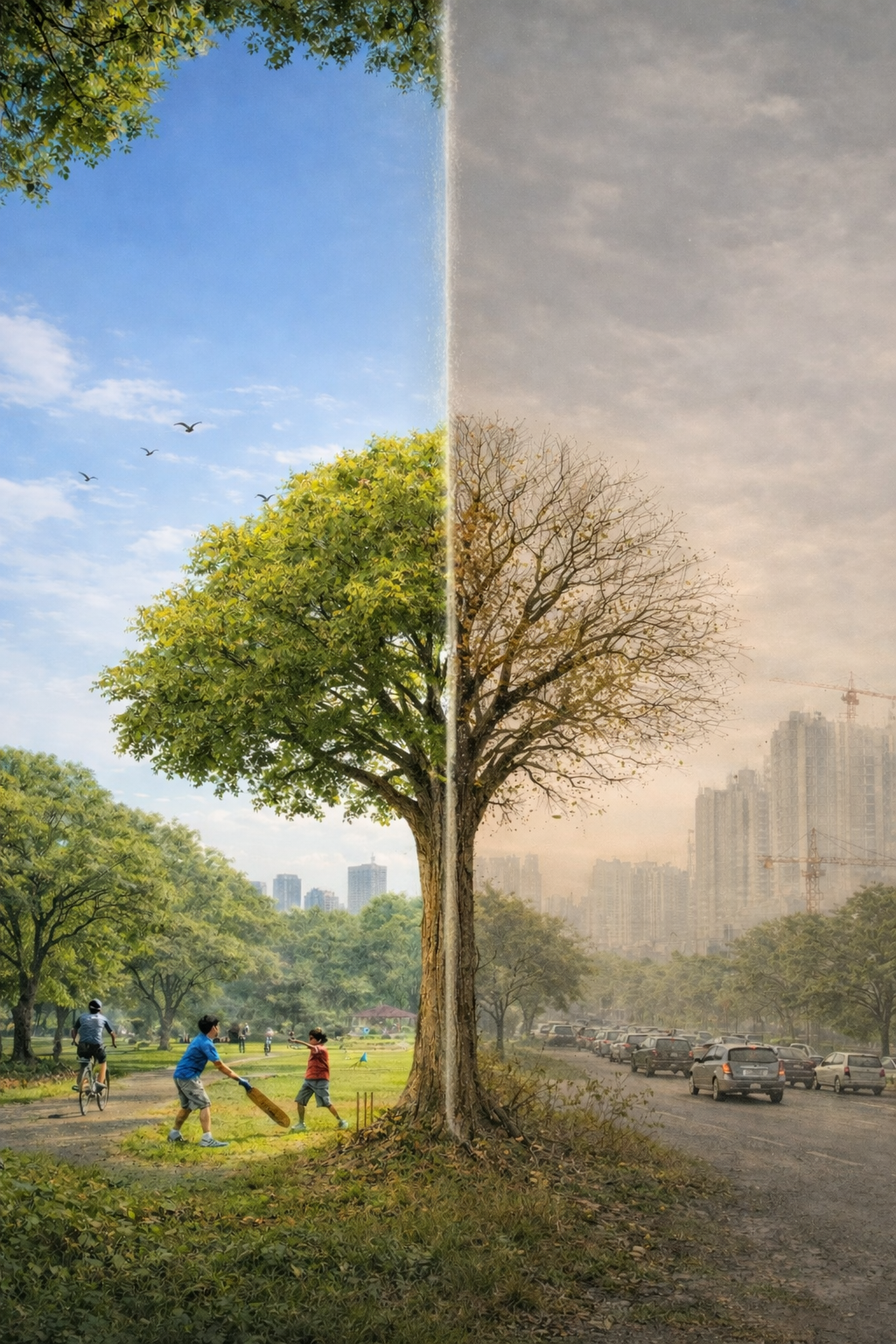
There was a time when Bengaluru’s greatest luxury was invisible. The air felt light. Morning walks didn’t strain the lungs. Elderly parents sat on balconies without checking pollution levels. Children played in parks until sunset without anyone worrying about what they were breathing. Air was trusted.
Today, it is measured.
In 2025, out of 361 monitored days, only two qualified as good. By December, the average Air Quality Index stood at 143, with peaks above 175. On high-pollution days, living here is like smoking three cigarettes a day not enough to shock you in a moment, but enough to cause slow, lasting harm. These are not just numbers. They are breaths we take every day.
PM2.5 particles, nearly 30 times thinner than a human hair, slip past our lungs’ defenses and enter the bloodstream. They come from traffic, construction, and waste burning. Even when the sky looks clear, they remain. Pollution is no longer something we see. It is something we carry inside us. Policies exist. Targets are announced. Yet Bengaluru’s trajectory shows inconsistent progress. Traffic expands. Buildings rise. Waste burns. Small actions add up. Big problems need big courage.
Pollution does not stop at city borders. Tumkur has recorded AQI levels near 180, sometimes higher than Bengaluru itself. Urban growth without environmental care does not leave pollution behind it carries it forward.
Cities rarely collapse dramatically. Instead, they erode gradually when expectations shrink when what once felt unacceptable becomes manageable, and when masks become habits rather than warnings. The crisis is not that Bengaluru has become polluted. The crisis is quieter than that. It is that Bengaluru is no longer the city it once was and we are learning to live with the loss instead of resisting it.
Because this change is no longer something we see. It is something we breathe.
A father buys an air purifier for his child’s bedroom without asking why it has become necessary. A morning runner steps outside at dawn, breathing whatever the city releases that day, calling it exercises. Damage does not announce itself. It settles quietly into life. Eventually, it becomes ordinary just another Tuesday.
First, India should adopt automated pollution compliance systems where industrial emissions crossing permitted limits trigger instant digital penalties, similar to automated traffic challans. Countries like Germany already use continuous monitoring that automatically reports violations, making enforcement unavoidable. This removes discretion, delays, and selective action turning environmental law into a certainty rather than a warning.
Transparent and localized AQI data can change behavior only when pollution becomes impossible to ignore in daily life. When air quality information stays inside mobile apps or government websites, it remains abstract and easy to overlook. But if AQI levels are displayed openly on digital boards at bus stops, schools, office entrances, and traffic signals just like temperature or time pollution becomes a shared public reality rather than private information.
Imagine children seeing a red “hazardous air” indicator outside their school every morning, employees entering workplaces where air quality warnings are visible, or commuters watching AQI numbers rise during peak hours. Such visibility transforms pollution from a background issue into an immediate social concern, prompting conversations, questions, and pressure for action. When people repeatedly confront evidence of unsafe air in common spaces, complacency reduces and collective accountability grows, because the problem is no longer invisible it becomes part of everyday public consciousness.
There is no alternate atmosphere waiting elsewhere. The consequences will not arrive loudly. They will appear quietly in inhalers carried in school bags, in medical reports, and in a persistent fatigue that feels difficult to explain.
This is not about preserving a city’s reputation. It is about preserving something far more fundamental the simple human ability to breathe without harm.
The responsibility is collective.The moment is now.Silence is not neutrality.It is consent.